DOT Metal Push-to-Connect Fittings: The Complete Guide

Table of Contents
- What Is a DOT Metal Push-to-Connect Fitting?
- What "DOT-Approved" Actually Means
- Why DOT Fittings Are Metal, Not Composite
- Where DOT Fittings Belong — and Where They Don't
- The True Cost of a Cheap DOT Fitting
- How to Choose the Right DOT Fitting
- Specifications at a Glance
- Installation, in Brief
- Buy DOT Fittings on Compliance, Not Price
- FAQs
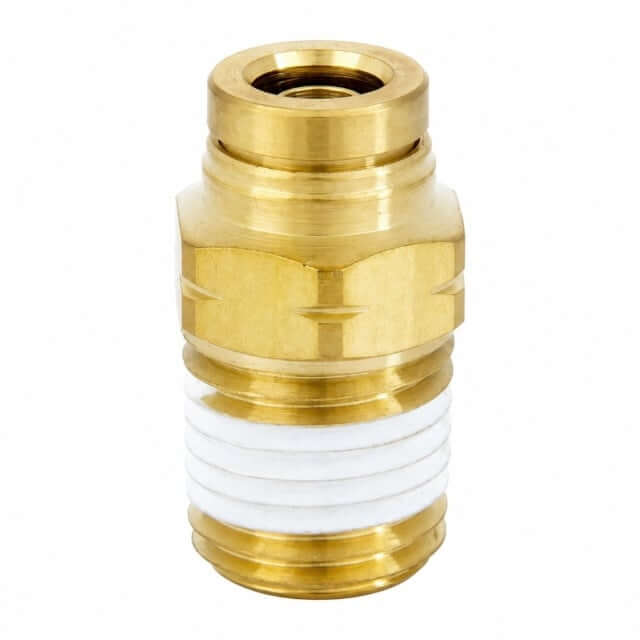
A DOT metal push-to-connect fitting is a brass tube fitting that seals a nylon air-brake tube — the properly prepared tube pushes directly into the fitting, with no flaring, compression nut, or tools on the tube end. It's used where SAE J844 nylon air-brake tubing terminates on a commercial truck or trailer, and it's built to stay leak-free under the vibration, pressure, and wide temperature swings of vehicle air systems. Per the manufacturer, the PneumaticPlus PT line complies with Federal Motor Vehicle Safety Standard No. 106 (FMVSS No. 106), 49 CFR 571.106, SAE J2494-3, and SAE J1131.
This guide is the complete reference: what these fittings are, how the mechanism works, what "DOT-approved" actually means, how to choose the right configuration, and — the part most buyers get wrong — why the lowest-priced fitting is often the most expensive one you can install. Each section links to a deeper article, and everything ties back to the fittings we stock.
Shop DOT Approved Metal Push-to-Connect Fittings →
📚 The Complete DOT Push-to-Connect Reference
In-depth guides for fleet maintenance, engineers, procurement teams, and industrial buyers. Start here, then go deeper on any topic.
What Is a DOT Metal Push-to-Connect Fitting?
A DOT metal push-to-connect fitting — also called a DOT push-in fitting — is a brass tube fitting that accepts a properly prepared nylon air tube pushed straight in and forms an immediate, reusable seal. "DOT" means the fitting is built to the federal framework for vehicle air-brake components; "metal" means the body is brass rather than composite. The PneumaticPlus PT line is brass and DOT-compliant per the manufacturer.
Inside, a PT fitting has a brass body and release ring, a stainless-steel gripping ring (collet), PEI holding and protection rings, and an NBR seal. The design also incorporates an internal tube support for use with the nylon tube. When you push the tube in, it passes the gripping ring — which lets it slide in but bites into the tube's outer surface if it's pulled — and the NBR seal closes against the tube's outer diameter, while the internal support reinforces the nylon tube so the connection holds under vibration and pressure. To disconnect, press the release ring and pull the tube straight out.
What "DOT-Approved" Actually Means
Here's a detail worth understanding: the Department of Transportation does not inspect fittings or issue a "DOT-approval" sticker. Compliance is self-certification. Under 49 U.S.C. Chapter 301, the manufacturer certifies that its equipment meets the applicable Federal Motor Vehicle Safety Standard — here, FMVSS No. 106 (49 CFR 571.106) — and NHTSA audits rather than pre-approving parts. NHTSA has stated that it does not approve motor vehicle equipment; manufacturers certify compliance themselves.
Because compliance is self-certified, the manufacturer and the documented standard behind a part are what give the "DOT" label meaning. SAE J2494-3 is the standard directed at push-to-connect fittings — it sets the performance criteria and test methods for push-to-connect assemblies used with SAE J844 air-brake tubing — and the PT line's compliance with it is stated by the manufacturer. How to check that a fitting is backed this way is covered in How to Spot Fake or Non-Compliant "DOT" Fittings.
Why DOT Fittings Are Metal, Not Composite
DOT push-to-connect fittings come in brass (metal) and composite bodies. Composite is lighter and cheaper; the brass body earns its place where it counts — resisting sparks, chips, coolant, and impact, and holding thread torque over years of heat cycling. Every DOT fitting PneumaticPlus stocks is brass.
If your application genuinely doesn't need DOT certification — general shop air, machine plumbing, non-brake accessories — you don't need to pay for it; our regular composite push-to-connect fittings and metal push-to-connect fittings cover that at a lower price. For a commercial-vehicle air-brake circuit, use a DOT-compliant fitting.
Where DOT Fittings Belong — and Where They Don't
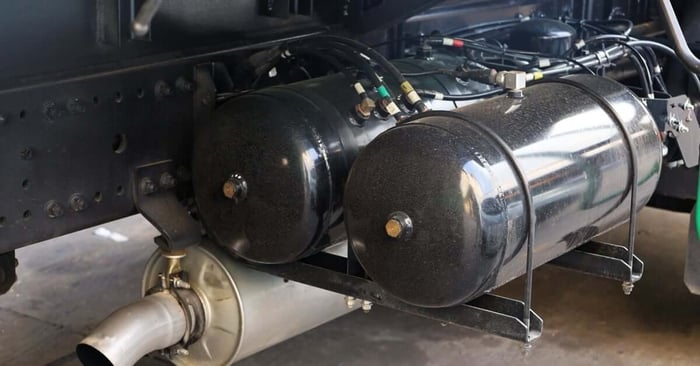
Under 49 CFR 393.45(a), all brake tubing, hoses, brake hose assemblies, and end fittings must meet the requirements of FMVSS No. 106, and under 393.45(d) every brake connection must be installed to ensure an attachment free of leaks, constrictions, or other conditions that would affect braking. Push-to-connect fittings serve the nylon-tubing runs in that system.
There is one place they're not designed to go: per the manufacturer, the PT line is designed for all pneumatic circuits except between the frame and axle, or between a towed and towing vehicle — the high-movement joints, which use flexing hose assemblies instead. Push-to-connect handles the tubing runs; it doesn't replace those flexing connections.
The True Cost of a Cheap DOT Fitting
When a compliant brass DOT fitting costs a few dollars and an unbranded import costs less, the gap looks like a saving — but the purchase price is usually the smallest number in the equation. An air-brake connection that leaks or was never truly compliant carries costs that dwarf the part: under the CVSA 2026 North American Standard Out-of-Service Criteria, a leak found at a push-to-connect fitting is documented as a violation, and a redo means paying the labor twice plus the truck's downtime. Weighed on total cost — compliance, rework, and downtime — a documented, standards-backed fitting is usually the better value. The full breakdown is in The True Cost of Cheap DOT Fittings.
How to Choose the Right DOT Fitting
Four decisions get you to the correct part:
- Tube OD and material. The fitting accepts one outer diameter, matched to SAE J844 (DOT) nylon tubing. The PT line covers 5/32" through 3/4".
- Thread type and size. PT threaded fittings use NPTF (Dryseal). A swivel body lets you aim the tube outlet after the thread is tight.
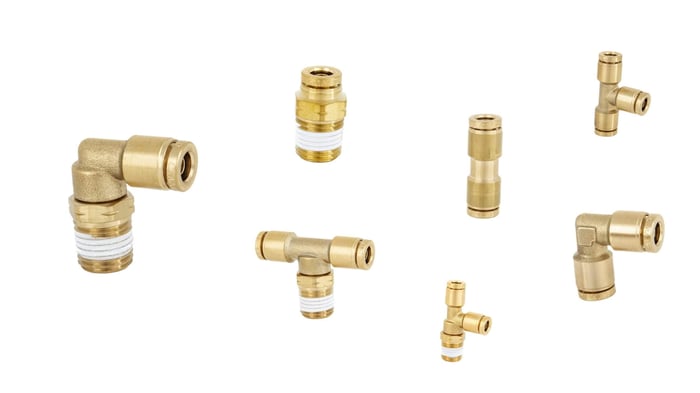
- Configuration. Plan the line route first, then count the nodes — straights, elbows, tees, unions, bulkheads.
- Seal. The PT line uses an NBR (low-temperature) seal as standard.
The PT series maps directly to those choices:
| Need | PT-Series Configuration |
|---|---|
| Tube to male thread | PT11 straight male; PT14 fixed male elbow; PT15 swivel male elbow; PT15-45 45° swivel |
| Tube to female thread | PT13 female straight; PT17 swivel female elbow |
| Tube to tube | PT26 union; PT28 union elbow; PT29 union tee |
| Branch / distribution | PT20 & PT20-F swivel tees; PT23 lateral run tee |
| Panel / frame pass-through | PT27 & PT27-F bulkhead union |
| Threadless valve-body cavity | PT10 press-in cartridge (SAE J2494-4 aluminum cavity) |
Full walkthroughs live in How to Choose the Right DOT Fitting and DOT Configurations Explained: PT10–PT29.
Specifications at a Glance
| Parameter | PT Line Specification |
|---|---|
| Compliance (per manufacturer) | FMVSS No. 106 (49 CFR 571.106); SAE J2494-3; SAE J1131 |
| Body material | Brass (UNI EN 12164 CW614N / UNI EN 12165 CW617N) |
| Working pressure | Vacuum to 290 PSI — verify for the selected fitting and application |
| Temperature range | −55 °F to +212 °F |
| Gripping ring (collet) | Stainless steel AISI 301 |
| Seal | NBR (low temperature) |
| Tube support | Incorporated internal support for SAE J844 nylon tube |
| Threads | NPTF (Dryseal); bulkhead unions use a metric panel thread; unions and cartridge are threadless |
| Tube ODs | 5/32", 1/4", 3/8", 1/2", 5/8", 3/4" |
| Recommended tubing | PA (nylon) tubing complying with SAE (DOT) |
Installation, in Brief
Most leaks trace to installation, not the part. Per the manufacturer's instructions: cut the tube square at 90° with a proper tube cutter, leaving no burrs and no oval, then push the tube straight in until it bottoms. To release, press the release ring and pull the tube straight out. Keep the tube free of pulling load, respect its minimum bending radius, and keep objects off the release ring — pressure on it can release the tube. The full method is in How to Install DOT Push-to-Connect Fittings Correctly and Why DOT Fittings Leak (and How to Fix It).
Buy DOT Fittings on Compliance, Not Price
A DOT metal push-to-connect fitting is a small part carrying a large responsibility. The right one is built to a documented standard, backed by a named manufacturer, brass where it counts, and matched correctly to your tube and port. That's the standard the PneumaticPlus PT line is built to.
Browse the PneumaticPlus DOT Metal Push-to-Connect Line →
📚 Go Deeper
→ The True Cost of Cheap DOT Fittings
→ How to Choose the Right DOT Fitting
Educational information only. This article is provided by PneumaticPlus for general educational and informational purposes only. It is not legal, engineering, regulatory, or compliance advice, and it creates no advisory relationship. Standards and regulations — including FMVSS, SAE, and FMCSA/CVSA rules — are periodically revised, may be superseded, and vary by jurisdiction and application. Nothing here should be relied on to determine compliance. All specifications, standards, part numbers, and regulatory references must be independently verified against the current official primary sources (the eCFR, SAE International, NHTSA, and CVSA) and the manufacturer's datasheet, and confirmed with a qualified professional before any purchasing, installation, maintenance, or compliance decision. PneumaticPlus makes no representation or warranty as to the accuracy, completeness, or currency of this information and disclaims all liability for reliance on it.