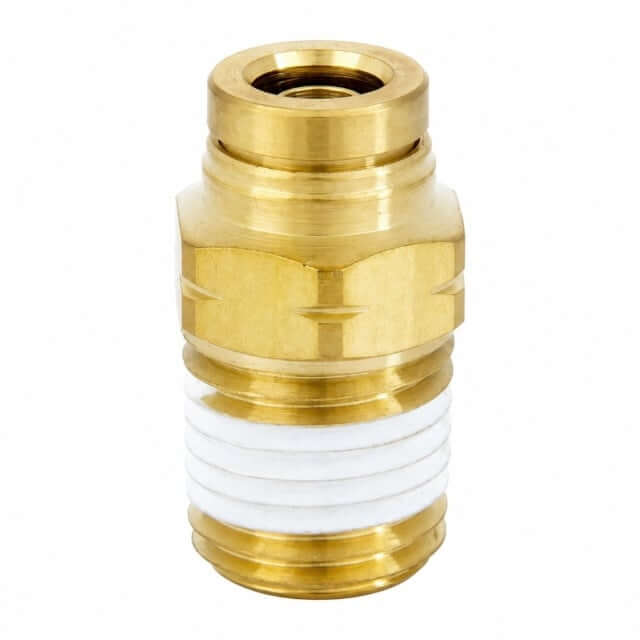
DOT-Rated vs. Standard Pneumatic Push-to-Connect Fittings

Table of Contents
DOT-rated and standard pneumatic push-to-connect fittings use the same push-in principle, but they're built and certified for different jobs — and they're not interchangeable. A DOT-rated fitting is certified for commercial-vehicle air-brake service; a standard pneumatic fitting is a general-purpose part for shop air, machinery, and industrial pneumatics. The right one depends entirely on the application — and buying more than you need, or less, both cause problems.
Same Principle, Different Purpose
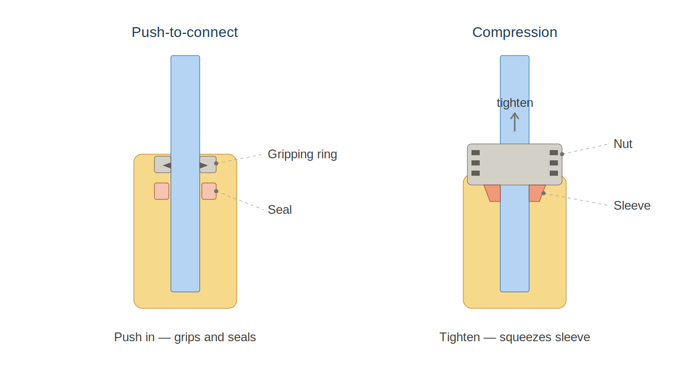
Both types connect a tube pushed in by hand, using a gripping ring and a seal. The difference is what they're built and certified to do. A DOT-rated push-to-connect fitting is made for the air-brake circuit of a commercial vehicle and is certified to Federal Motor Vehicle Safety Standard No. 106 (FMVSS No. 106) and the applicable SAE standards — for push-to-connect, SAE J2494-3. A standard pneumatic fitting carries no such federal certification because it isn't intended for that use.
When You Need DOT
Use a DOT-rated fitting whenever the connection is part of a commercial-vehicle air-brake system. Under 49 CFR 393.45(a), all brake tubing, hoses, assemblies, and end fittings must meet FMVSS No. 106 — so on a brake circuit, a standard pneumatic fitting isn't an option, regardless of how similar it looks. That's not a place to substitute on price or availability.
When a Standard Fitting Is the Right Call
For everything that isn't a vehicle brake circuit — shop air lines, machine plumbing, FRL feeds, tool drops, general industrial pneumatics, and non-brake vehicle accessories — a standard pneumatic push-to-connect fitting is the appropriate, cost-effective choice. Paying for DOT certification you don't need adds cost without benefit.
PneumaticPlus stocks both, so you can match the part to the job:
- DOT air-brake circuits → the brass DOT metal push-to-connect (PT) series.
- General industrial / shop air → our composite push-to-connect fittings and metal push-to-connect fittings.
Can You Use a DOT Fitting for Industrial Work?
A brass DOT fitting is a robust part, and there's nothing wrong with using one in a demanding industrial spot where its durability is welcome. The reverse is not true: a standard pneumatic fitting must not be used in a commercial-vehicle brake circuit, because it isn't certified for it. So the rule of thumb is simple — DOT where the brake circuit requires it; standard where it doesn't, unless you specifically want the brass fitting's robustness.
Shop DOT Push-to-Connect Fittings →
📚 Related Reading
→ Metal vs. Composite DOT Push-to-Connect Fittings
Educational information only. This article is provided by PneumaticPlus for general educational and informational purposes only. It is not legal, engineering, regulatory, or compliance advice, and it creates no advisory relationship. Standards and regulations — including FMVSS, SAE, and FMCSA/CVSA rules — are periodically revised, may be superseded, and vary by jurisdiction and application. Nothing here should be relied on to determine compliance. All specifications, standards, and regulatory references must be independently verified against the current official primary sources and the manufacturer's datasheet, and confirmed with a qualified professional before any purchasing, installation, or compliance decision. PneumaticPlus makes no representation or warranty as to the accuracy, completeness, or currency of this information and disclaims all liability for reliance on it.