DOT Fitting Compliance Explained: FMVSS No. 106, SAE J844, and the Standards Behind Every Air-Brake Connection

Table of Contents
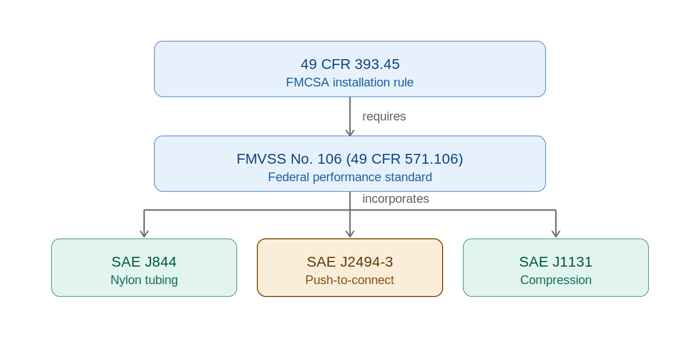
DOT fitting compliance isn't a single rule — it's a small stack of federal regulations and SAE standards that reference one another. For an air-brake push-to-connect fitting, the short version is: an FMCSA installation rule (49 CFR 393.45) requires the parts to meet Federal Motor Vehicle Safety Standard No. 106 (FMVSS No. 106), which in turn incorporates the SAE standards that describe how those fittings and tubing are dimensioned and tested. Understanding how the pieces fit is what lets a fleet manager, engineer, or buyer specify the right part with confidence.
This guide maps the framework, explains what each layer does, and clears up two things that are commonly confused — which SAE standard actually governs push-to-connect fittings, and what a roadside inspector does with a leak at a fitting.
The Compliance Stack, Top to Bottom
- FMCSA installation rule — 49 CFR 393.45. The operational requirement. It states that all brake tubing, hoses, brake hose assemblies, and end fittings must meet the applicable requirements of FMVSS No. 106, and that every brake connection must be installed to ensure an attachment free of leaks, constrictions, or other conditions that would affect braking.
- Federal standard — FMVSS No. 106 (49 CFR 571.106). Sets the labeling, performance, and test requirements for brake hoses, hose assemblies, and end fittings on trucks, buses, trailers, and multipurpose vehicles.
- SAE standards. FMVSS No. 106 incorporates the substantive SAE recommended practices that describe the tubing and fittings — including a category for plastic air-brake tubing, end fittings, and tubing assemblies added to the standard in 2004.
A part is genuinely compliant only when all of that holds together: built and tested to the right SAE standards, meeting FMVSS No. 106, and installed per the FMCSA rule.
49 CFR 393.45 — the Installation Rule
This is the anchor most people cite. Two subsections matter most for fittings. 393.45(a) requires that all brake tubing, hoses, hose assemblies, and end fittings meet the applicable requirements of FMVSS No. 106. 393.45(d) requires that all connections for air, vacuum, or hydraulic braking systems be installed to ensure an attachment free of leaks, constrictions, or other conditions that would adversely affect brake performance.
One correction worth noting, because older references get it wrong: 49 CFR 393.46 is now reserved. The tubing-and-fitting requirements it once carried were moved into FMVSS No. 106, so the connection requirement to cite today is 393.45(d), not 393.46.
FMVSS No. 106 — the Federal Standard
FMVSS No. 106 sets labeling and performance requirements for brake hoses, hose assemblies, and end fittings, to reduce the likelihood of brake failure from a rupture. It's the standard the FMCSA rule points to, and it's what a manufacturer self-certifies against.
A quick point that clears up a persistent confusion: FMVSS No. 106 includes a requirement that an air-brake hose assembly, after salt-spray exposure, withstand 900 psi hydrostatic pressure without rupture. That figure is often quoted as if it were a push-to-connect fitting's rating — it isn't. It's a rubber-hose-assembly requirement. Push-to-connect fittings used with plastic (nylon) air-brake tubing fall under a different part of the standard and the SAE standards written for that category. When you see "900 psi," it's a hose-assembly benchmark, not a working pressure for a plastic-tubing push-to-connect part.
Which SAE Standard Governs Push-to-Connect?
This is the detail most articles get muddled. The SAE standards break down like this:
| Standard | What it covers |
|---|---|
| SAE J844 | Nonmetallic (nylon) air-brake tubing |
| SAE J2494-1 | Dimensional spec for metallic-body push-to-connect air-brake fittings |
| SAE J2494-3 | Performance criteria and test methods for push-to-connect fittings used with SAE J844 tubing |
| SAE J2494-4 | Aluminum cavity dimensions for press-in (cartridge) fittings |
| SAE J1131 | Performance for J844 tubing with compression fitting assemblies |
The one directed at push-to-connect fittings is SAE J2494-3. SAE J1131 is the parallel performance standard for the older compression-style fittings. A manufacturer may state compliance with both — the PneumaticPlus PT line is stated to comply with SAE J2494-3 and SAE J1131 — but it's J2494-3 that specifically addresses push-to-connect design and testing. (The full texts of these SAE standards are published by SAE International; the designations and scope above are what matter for selection.)
What "DOT" Certifies — and Who Certifies It
The government does not pre-approve fittings. Under 49 U.S.C. Chapter 301, the manufacturer certifies that its equipment meets the applicable FMVSS, and NHTSA audits rather than approving parts in advance. NHTSA has stated directly that it does not approve motor vehicle equipment.
How the "DOT" mark shows up depends on the part. For crimped or swaged air-brake hose assemblies, FMVSS No. 106 requires a band bearing the "DOT" symbol — the assembler's certification — plus a manufacturer designation registered with NHTSA. Reusable push-to-connect bodies sold loose aren't necessarily stamped that way, so the meaningful test for a push-to-connect fitting is the manufacturer's stated compliance and documentation, not a stamp.
Where the Rules Draw a Line
Two placement points are worth knowing. First, coiled nonmetallic tubing is specifically permitted by 393.45(c) for connections between towed and towing vehicles, or between a towed vehicle's frame and an adjustable axle's subframe, under stated conditions. Second, push-to-connect fittings themselves are designed for the tubing runs, not those flexing joints — per the manufacturer, the PT line is designed for all pneumatic circuits except between the frame and axle or between a towed and towing vehicle, where flexing hose assemblies are used instead.
What a Roadside Inspection Actually Does
The enforcement standard is the CVSA North American Standard Out-of-Service Criteria, and the 2026 edition took effect April 1, 2026, replacing all previous versions (the criteria are updated annually, effective April 1). For fittings, the nuance is important and often misunderstood: per CVSA's inspection guidance, a leak found at a push-to-connect fitting is documented as a violation but is not declared out of service, whereas a leak in the hose or tubing itself is an out-of-service condition. So "not automatically out-of-service" is not the same as "acceptable" — a fitting leak is still a documented violation to be repaired.
A Compliance Checklist
| # | Verify |
|---|---|
| 1 | Fitting is from a named manufacturer stating compliance with FMVSS No. 106 |
| 2 | Compliance with the applicable SAE standards is stated (SAE J2494-3 for push-to-connect) |
| 3 | Tubing is SAE J844 (DOT) nylon of the correct OD |
| 4 | The connection is installed leak-free per 49 CFR 393.45(d) |
| 5 | The fitting is used within its intended application (not the frame-axle or towed-towing joints) |
| 6 | Specs and documentation are available from the supplier on request |
Shop DOT Metal Push-to-Connect Fittings →
📚 Related Reading
→ DOT Metal Push-to-Connect Fittings: The Complete Guide
Educational information only. This article is provided by PneumaticPlus for general educational and informational purposes only. It is not legal, engineering, regulatory, or compliance advice, and it creates no advisory relationship. Standards and regulations — including FMVSS, SAE, and FMCSA/CVSA rules — are periodically revised, may be superseded, and vary by jurisdiction and application. Nothing here should be relied on to determine compliance. All specifications, standards, part numbers, and regulatory references must be independently verified against the current official primary sources (the eCFR, SAE International, NHTSA, and CVSA) and the manufacturer's datasheet, and confirmed with a qualified professional before any purchasing, installation, maintenance, or compliance decision. PneumaticPlus makes no representation or warranty as to the accuracy, completeness, or currency of this information and disclaims all liability for reliance on it.