The True Cost of Cheap DOT Fittings: Why the Lowest Price Costs More

Table of Contents
On an air-brake circuit, the cheapest DOT fitting is often the most expensive one you can install — because the purchase price is the smallest number in the total cost. The parts that win on sticker price routinely lose on everything that comes after: roadside violations, rework, downtime, and liability. This is the case for buying DOT air-brake fittings on documented compliance and total cost, not on the lowest line item.
It's a timely question. When a compliant brass DOT fitting costs a little more than an unbranded import, the gap looks like an easy saving. It's worth being precise about what that gap actually represents — and what it hides.
The Price Gap Is an Illusion
A fitting isn't bought for its price — it's bought to hold an air-brake connection together for years, under vibration, pressure cycling, and a wide temperature range. The relevant question isn't "what does this part cost?" It's "what does a failed or non-compliant connection cost?" Once you price that in, the cheap fitting is usually the expensive one.
What You're Actually Paying Less For
A DOT fitting that undercuts the market on price usually got there by removing things you can't see in a listing photo:
- A named, accountable manufacturer. Genuine DOT compliance is self-certified by a manufacturer who stands behind the part. "DOT compliant" typed into a bargain listing, with no named manufacturer behind it, is a marketing string — not a certification.
- A documented standard. No stated compliance with Federal Motor Vehicle Safety Standard No. 106 (FMVSS No. 106) and the applicable SAE standards means nothing to show an inspector, an auditor, or an insurer after an incident.
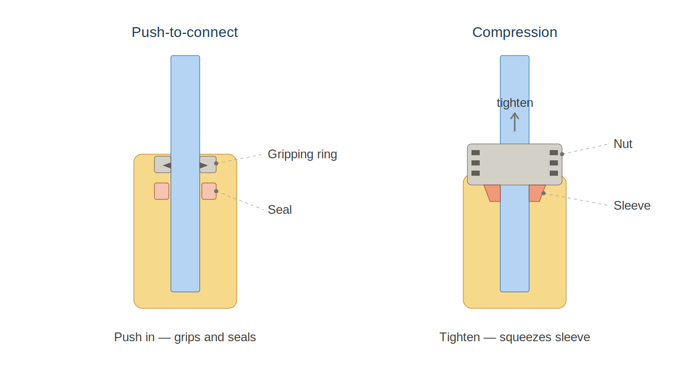
- Correct construction for the tube. A compliant push-to-connect fitting is built and specified to seal SAE J844 (DOT) nylon tubing reliably. Parts that skimp here can pass a hand-test on the bench and let go under real vibration.
- Consistent, sourced specifications. Real material, pressure, and temperature data — not round numbers with no basis.
The Costs That Dwarf the Purchase Price
1. Roadside violations. A leaking or improperly installed air-brake connection is a defect under 49 CFR 393.45(d), which requires connections free of leaks. Under the CVSA 2026 North American Standard Out-of-Service Criteria, a leak found at a push-to-connect fitting is documented as a violation (a leak in the hose or tubing itself is an out-of-service condition). Either way, it's a finding against the vehicle — and CVSA guidance also notes that an end-fitting repair not marked as FMVSS/CMVSS No. 106 compliant may be documented as a violation.
2. Failure and safety exposure. A connection that fails under vibration on a brake circuit isn't a maintenance ticket — it's a loss of air where it matters most. That's the one failure mode a fleet can't treat as routine, and it's exactly the mode undocumented parts are prone to.
3. Rework and downtime — paid twice. A fitting that has to be cut out and redone costs the second installation's labor on top of the first, plus the truck's time off the road while it happens. A small saving on the part evaporates the moment a technician touches it a second time.
4. Liability after an incident. Running undocumented parts in a federally regulated brake circuit is an exposure that surfaces at the worst possible time — after a failure, when the question becomes what was installed and whether it was compliant. Documented, standards-backed parts are a defensible answer; anonymous imports are the opposite.
The Total-Cost Picture
| Cost layer | Cheap / undocumented fitting | Documented brass fitting |
|---|---|---|
| Purchase price | Lowest | A little more |
| Documentation | None | Stated FMVSS No. 106 / SAE compliance |
| Rework risk | Elevated | Low |
| Roadside exposure | Higher | Lower |
| Liability position | Weak | Defensible |
| True cost over service life | Highest | Lowest |
How to Buy on Total Cost
The screen is short, and any reputable supplier can answer it:
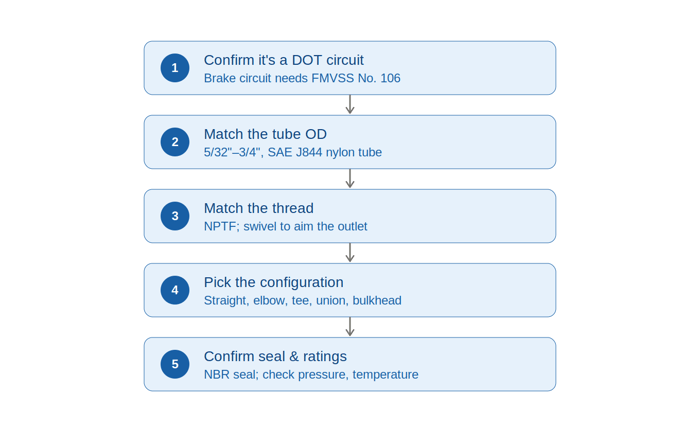
- Is there a named, identifiable manufacturer behind the part?
- Is stated compliance with FMVSS No. 106 and the applicable SAE standards available?
- Is the fitting designed for SAE J844 (DOT) nylon tubing?
- Is the body brass, with real specifications from a datasheet — not round numbers with no source?
If a fitting can't clear that screen, its low price isn't a saving — it's a deferred cost. For the full identification method, see How to Spot Fake or Non-Compliant "DOT" Fittings.
The PneumaticPlus Standard
Every DOT fitting we stock is brass, designed for SAE J844 (DOT) nylon tubing, and backed by the manufacturer's stated compliance with FMVSS No. 106, SAE J2494-3, and SAE J1131. It's chosen to be the lowest total cost over the life of the connection — which is the only cost that matters on a brake circuit.
Shop Documented DOT Metal Push-to-Connect Fittings →
📚 Related Reading
→ DOT Metal Push-to-Connect Fittings: The Complete Guide
Educational information only. This article is provided by PneumaticPlus for general educational and informational purposes only. It is not legal, engineering, regulatory, or compliance advice, and it creates no advisory relationship. Standards and regulations — including FMVSS, SAE, and FMCSA/CVSA rules — are periodically revised, may be superseded, and vary by jurisdiction and application. Nothing here should be relied on to determine compliance. All specifications, standards, and regulatory references must be independently verified against the current official primary sources (the eCFR, SAE International, NHTSA, and CVSA) and the manufacturer's datasheet, and confirmed with a qualified professional before any purchasing, installation, maintenance, or compliance decision. PneumaticPlus makes no representation or warranty as to the accuracy, completeness, or currency of this information and disclaims all liability for reliance on it.