Metal vs. Composite DOT Push-to-Connect Fittings: Why Choose Brass

Table of Contents
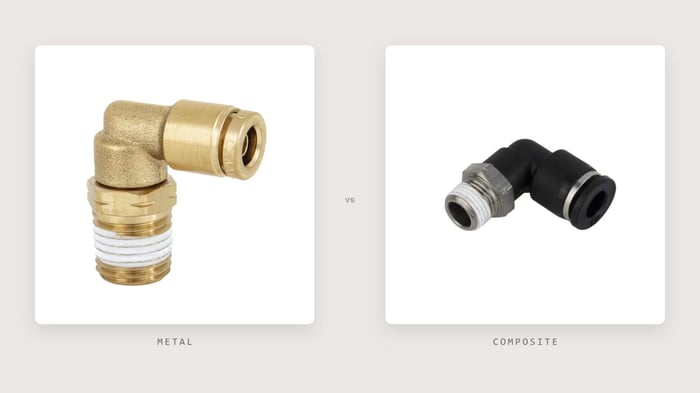
DOT push-to-connect fittings come in both brass (metal) and composite bodies — and the difference between them is a material trade-off, not a compliance one. A composite-bodied fitting can be built to the same performance standards; the reason many fleets choose brass for air-brake service is durability. This article explains the real differences, when each material fits, and which one PneumaticPlus stocks.
Both Can Be Compliant — the Difference Is Material
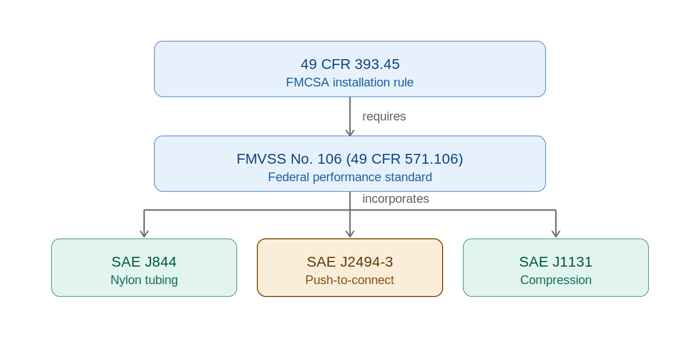
It's worth being precise: composite (non-metallic) DOT push-to-connect fittings exist and can be built to the applicable performance standards, just as metal ones are. The metallic push-to-connect dimensional standard is SAE J2494-1, and the performance standard for push-to-connect assemblies with SAE J844 tubing is SAE J2494-3, which a fitting of either body material can be certified to. So choosing brass over composite isn't about one being "DOT" and the other not — it's about which material suits the service.
Why Brass Is Chosen for Air-Brake Service
A brass body earns its place where conditions are demanding:
- Durability under abuse. Brass resists sparks, chips, coolant, and impact better than a polymer body — relevant around compressors, in the shop, and in exposed routing.
- Thread integrity over time. A brass body holds thread torque through years of heat cycling without the creep a polymer thread can be prone to.
- Temperature and mechanical robustness. Brass takes the mechanical and thermal knocks of over-the-road service well.
These are the reasons brass is the traditional choice for the harder corners of a vehicle air system — and it's the material PneumaticPlus stocks for its DOT line.
Where Composite Makes Sense
Composite bodies have real advantages too, and it's fair to name them: they're lighter, which matters where weight reduction is a goal, and they're typically lower in cost. For applications where those priorities outweigh the durability of brass, composite is a reasonable choice.
The key is matching the material to the job rather than assuming one is universally better. For demanding air-brake service, brass; where weight and cost lead and conditions are milder, composite can fit.
What PneumaticPlus Stocks
Every DOT fitting PneumaticPlus carries is brass — the PT series, stated by the manufacturer to comply with FMVSS No. 106, SAE J2494-3, and SAE J1131. We do not stock composite DOT fittings.
If your application doesn't require DOT certification at all — general shop air, machine plumbing, or non-brake accessories — you don't need to pay for it. Our general-purpose composite push-to-connect fittings and metal push-to-connect fittings are built for those uses at a lower price. For a commercial-vehicle air-brake circuit, use the DOT brass PT series.
Shop Brass DOT Push-to-Connect Fittings →
📚 Related Reading
→ DOT Metal Push-to-Connect Fittings: The Complete Guide
Educational information only. This article is provided by PneumaticPlus for general educational and informational purposes only. It is not legal, engineering, regulatory, or compliance advice, and it creates no advisory relationship. Standards and regulations — including FMVSS, SAE, and FMCSA/CVSA rules — are periodically revised, may be superseded, and vary by jurisdiction and application. Nothing here should be relied on to determine compliance. All specifications, standards, and regulatory references must be independently verified against the current official primary sources (the eCFR, SAE International, NHTSA, and CVSA) and the manufacturer's datasheet, and confirmed with a qualified professional before any purchasing, installation, maintenance, or compliance decision. PneumaticPlus makes no representation or warranty as to the accuracy, completeness, or currency of this information and disclaims all liability for reliance on it.