How to Spot Fake or Non-Compliant "DOT" Fittings

Table of Contents
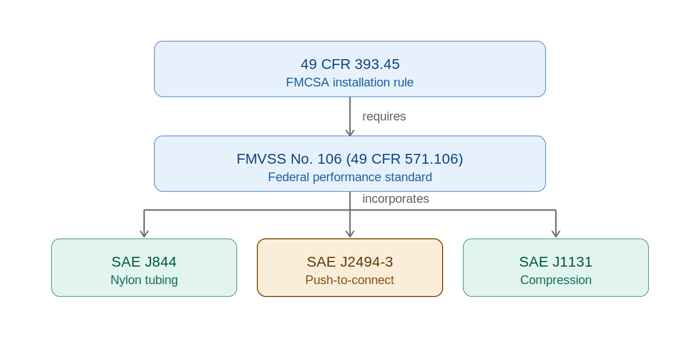
The most reliable way to tell a genuine DOT fitting from a fake or non-compliant one isn't a logo — it's whether a named, accountable manufacturer stands behind it with documented compliance to Federal Motor Vehicle Safety Standard No. 106 (FMVSS No. 106), 49 CFR 571.106, and the relevant SAE standards. Because DOT compliance is self-certified rather than granted by the government, the word "DOT" on a listing is only as trustworthy as the company that printed it.
That's not a small distinction on an air-brake circuit. This article explains why "DOT" alone proves nothing, what actually backs a legitimate fitting, the red flags that should give you pause, and a short checklist to run before you buy.
Why "DOT" on a Listing Isn't Proof
There is no government office that inspects a push-to-connect fitting and awards it a "DOT-approval" stamp. Under 49 U.S.C. Chapter 301, the manufacturer certifies that its equipment meets the applicable Federal Motor Vehicle Safety Standard — here, FMVSS No. 106 — and NHTSA audits compliance rather than pre-approving parts. NHTSA has stated plainly that it does not approve motor vehicle equipment; manufacturers certify it themselves.
The practical consequence: "DOT compliant" typed into a product title is a claim, not a certificate. A legitimate manufacturer makes that claim and stands behind it; anyone can also type the same three letters without the engineering or the accountability to back them. So verification isn't about finding the letters — it's about finding the company and the documentation behind them.
What Actually Backs a Genuine DOT Fitting
A legitimate DOT push-to-connect fitting is anchored by a few things you can actually check:
- A named, identifiable manufacturer who self-certifies compliance and can be held accountable for it — not an anonymous listing.
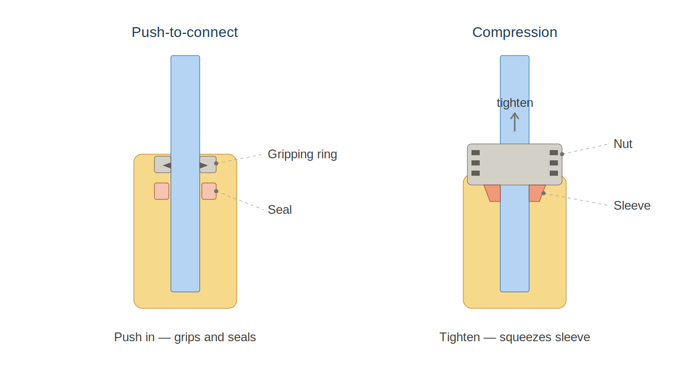
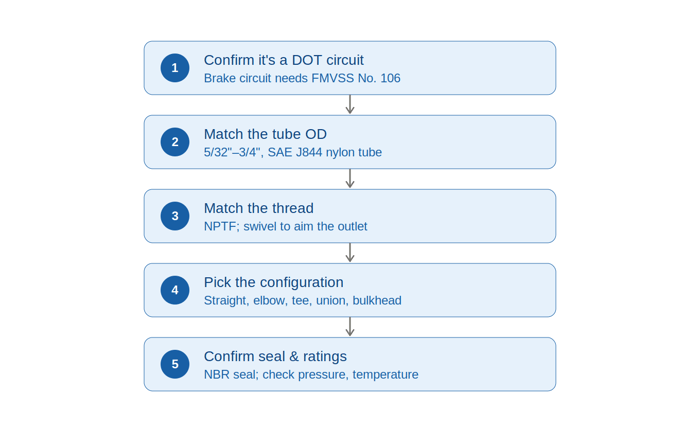
- A documented standard. The performance standard directed at push-to-connect fittings is SAE J2494-3, which sets the criteria and test methods for push-to-connect assemblies used with SAE J844 air-brake tubing; the fitting should be certified to FMVSS No. 106 and the applicable SAE standards.
- Consistent, plausible specifications — material, pressure, temperature, and tube sizes that match a real technical datasheet rather than round numbers with no source.
- Availability of compliance information on request. A serious supplier can point you to the manufacturer's stated compliance and technical documentation.
Note one nuance specific to push-to-connect: reusable push-to-connect bodies sold loose are not necessarily stamped "DOT" on the part the way a crimped or swaged air-brake hose assembly is (FMVSS No. 106 requires the "DOT" band on those hose assemblies). So the absence of a "DOT" stamp on a loose push-to-connect body isn't itself a red flag — the real test is the manufacturer and the documentation behind it.
Red Flags Worth a Second Look
None of these individually proves a fitting is non-compliant, but together they're reason to slow down and verify:
- No manufacturer named anywhere — just "DOT compliant" and a price.
- No technical datasheet, and no compliance information available when asked.
- Specifications that don't add up — for example, a working-pressure figure that looks like a burst number, or values with no stated basis.
- Mixed assortment kits with no per-part pressure, temperature, or standards data.
- A price far below the market for comparable compliant parts, with none of the backing above.
The theme is documentation and accountability. A compliant fitting is boringly well-documented; a questionable one tends to be conspicuously light on specifics.
What Roadside Inspectors Run Into
This isn't only a purchasing concern — it shows up at the roadside. Per CVSA's 2026 inspection guidance, compliant air-brake fittings can be difficult to identify during an inspection, because there are many OEM and aftermarket fittings and they may be marked in different places — on the wrench (hex) flats, on the face of the collet, or via colored caps — and some may not be obviously marked at all. CVSA guidance also notes that an end-fitting repair not marked as FMVSS/CMVSS No. 106 compliant may be documented as a violation.
The takeaway for a fleet: fittings that can't be tied back to a compliant manufacturer aren't just a purchasing risk, they can become an inspection finding. Buying documented parts up front avoids a question you don't want asked at a scale.
A Short Pre-Purchase Checklist
| Check | What good looks like |
|---|---|
| Manufacturer | Named and identifiable, not anonymous |
| Standard | Stated compliance with FMVSS No. 106 and the applicable SAE standards (SAE J2494-3 for push-to-connect) |
| Datasheet | Real specs — material, pressure, temperature, tube sizes — with a source |
| Documentation | Compliance information available on request |
| Tubing match | Designed for SAE J844 (DOT) nylon tubing |
Shop Documented DOT Metal Push-to-Connect Fittings →
📚 Related Reading
→ DOT Metal Push-to-Connect Fittings: The Complete Guide
Educational information only. This article is provided by PneumaticPlus for general educational and informational purposes only. It is not legal, engineering, regulatory, or compliance advice, and it creates no advisory relationship. Standards and regulations — including FMVSS, SAE, and FMCSA/CVSA rules — are periodically revised, may be superseded, and vary by jurisdiction and application. Nothing here should be relied on to determine compliance. All specifications, standards, and regulatory references must be independently verified against the current official primary sources (the eCFR, SAE International, NHTSA, and CVSA) and the manufacturer's datasheet, and confirmed with a qualified professional before any purchasing, installation, maintenance, or compliance decision. PneumaticPlus makes no representation or warranty as to the accuracy, completeness, or currency of this information and disclaims all liability for reliance on it.