DOT Push-to-Connect vs. Compression Fittings: Which to Use

Table of Contents
Push-to-connect and compression are two legitimate ways to make a DOT air-brake tube connection — the difference is how they seal and how you install them. A push-to-connect fitting accepts a prepared nylon tube pushed straight in and is governed, for this application, by SAE J2494-3. A compression fitting seals by tightening a threaded nut that compresses a sleeve onto the tube, and its performance standard with SAE J844 tubing is SAE J1131. Both can be built to comply with Federal Motor Vehicle Safety Standard No. 106 (FMVSS No. 106); the choice comes down to install speed, serviceability, and what your system already uses.
This guide explains how each method works, lays the two side by side, and covers when each makes sense — plus one important note about which type is the DOT option at PneumaticPlus.
How Push-to-Connect Works
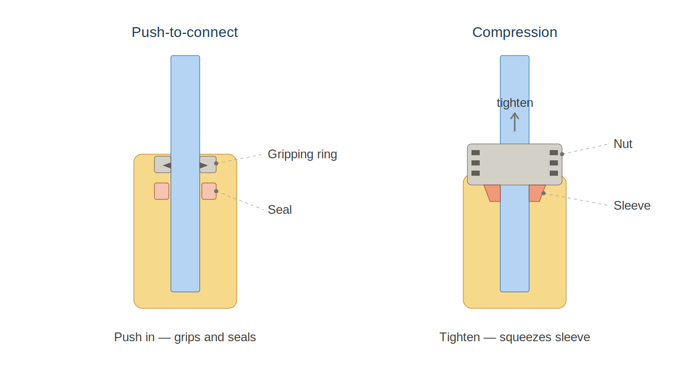
A push-to-connect fitting makes the connection in one motion: cut the tube square, push it into the fitting until it bottoms, and it's seated. Internally, a stainless-steel gripping ring lets the tube slide in but bites into its outer surface if pulled, a seal closes against the tube's outer diameter, and — on the PneumaticPlus PT line — an incorporated internal tube support reinforces the nylon tube. To disconnect, you press the release ring and pull the tube out. The performance standard directed at push-to-connect fittings used with SAE J844 tubing is SAE J2494-3.
How Compression Works
A compression fitting is the traditional threaded style. The tube passes through a nut and a sleeve (and, for nylon, typically a tube-support insert); tightening the nut compresses the sleeve onto the tube to form the seal. It's a familiar, long-established method. For SAE J844 nylon air-brake tubing, the compression-fitting performance standard is SAE J1131, and the dimensional standard for the sleeve-type fittings is SAE J246.
Side by Side
| Attribute | Push-to-Connect | Compression |
|---|---|---|
| How it seals | Internal gripping ring + seal on the tube OD | Nut compresses a sleeve onto the tube |
| Install | Cut square, push in until it bottoms | Cut square, slide nut/sleeve, thread and torque the nut |
| Tools on the connection | None on the tube end (hand push) | Wrench to tighten the nut |
| Disconnect | Press the release ring, pull the tube | Loosen the nut; sleeve is typically set onto the tube |
| SAE performance standard (with J844 tube) | SAE J2494-3 | SAE J1131 |
| Typical appeal | Speed, serviceability, tight spaces | Long track record, familiarity |
When to Choose Which
Push-to-connect tends to win where install speed and serviceability matter — quick connections, tight engine compartments, and lines that may be disconnected and reconnected during service. There's no tube-end tooling, and the body is reusable.
Compression appeals where a shop is standardized on it, where ports and existing plumbing are already compression-style, or simply where technicians prefer the familiar threaded method. Both are legitimate DOT air-brake connection methods when the fitting is built and certified for the job.
Whichever method you use, the compliance requirement is the same: on a commercial-vehicle air-brake circuit, the fitting must meet FMVSS No. 106 and be used with the correct SAE J844 (DOT) nylon tubing, installed leak-free per 49 CFR 393.45(d).
Which Is the DOT Option at PneumaticPlus?
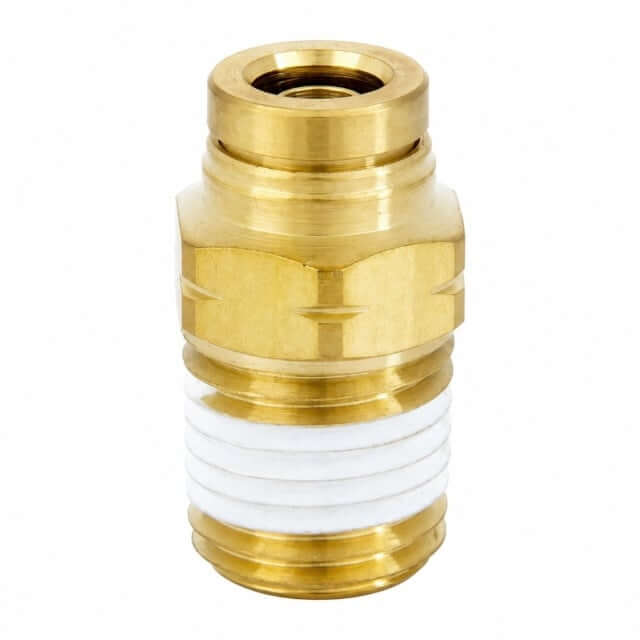
At PneumaticPlus, the DOT air-brake line is push-to-connect — the brass PT series, stated by the manufacturer to comply with FMVSS No. 106, SAE J2494-3, and SAE J1131. Our brass compression fittings are a general-purpose line and are not DOT-rated, so for a DOT brake connection, the PT push-to-connect series is the compliant PneumaticPlus choice.
Shop DOT Push-to-Connect Fittings →
📚 Related Reading
→ DOT Metal Push-to-Connect Fittings: The Complete Guide
Educational information only. This article is provided by PneumaticPlus for general educational and informational purposes only. It is not legal, engineering, regulatory, or compliance advice, and it creates no advisory relationship. Standards and regulations — including FMVSS, SAE, and FMCSA/CVSA rules — are periodically revised, may be superseded, and vary by jurisdiction and application. Nothing here should be relied on to determine compliance. All specifications, standards, and regulatory references must be independently verified against the current official primary sources (the eCFR, SAE International, NHTSA, and CVSA) and the manufacturer's datasheet, and confirmed with a qualified professional before any purchasing, installation, maintenance, or compliance decision. PneumaticPlus makes no representation or warranty as to the accuracy, completeness, or currency of this information and disclaims all liability for reliance on it.