Relieving vs. Non-Relieving Air Regulators

Table of Contents
- What "Relieving" Actually Means
- What "Non-Relieving" Means
- The Difference You'll Actually Notice
- Why Relieving Is Standard for Shop and Plant Air
- When a Non-Relieving Regulator Is the Right Choice
- The Limit Worth Knowing: Relieving Is Not Overpressure Protection
- How to Tell Which One You Have
- Troubleshooting: A Relieving Regulator That Won't Stop Venting
- Choosing Your Regulator
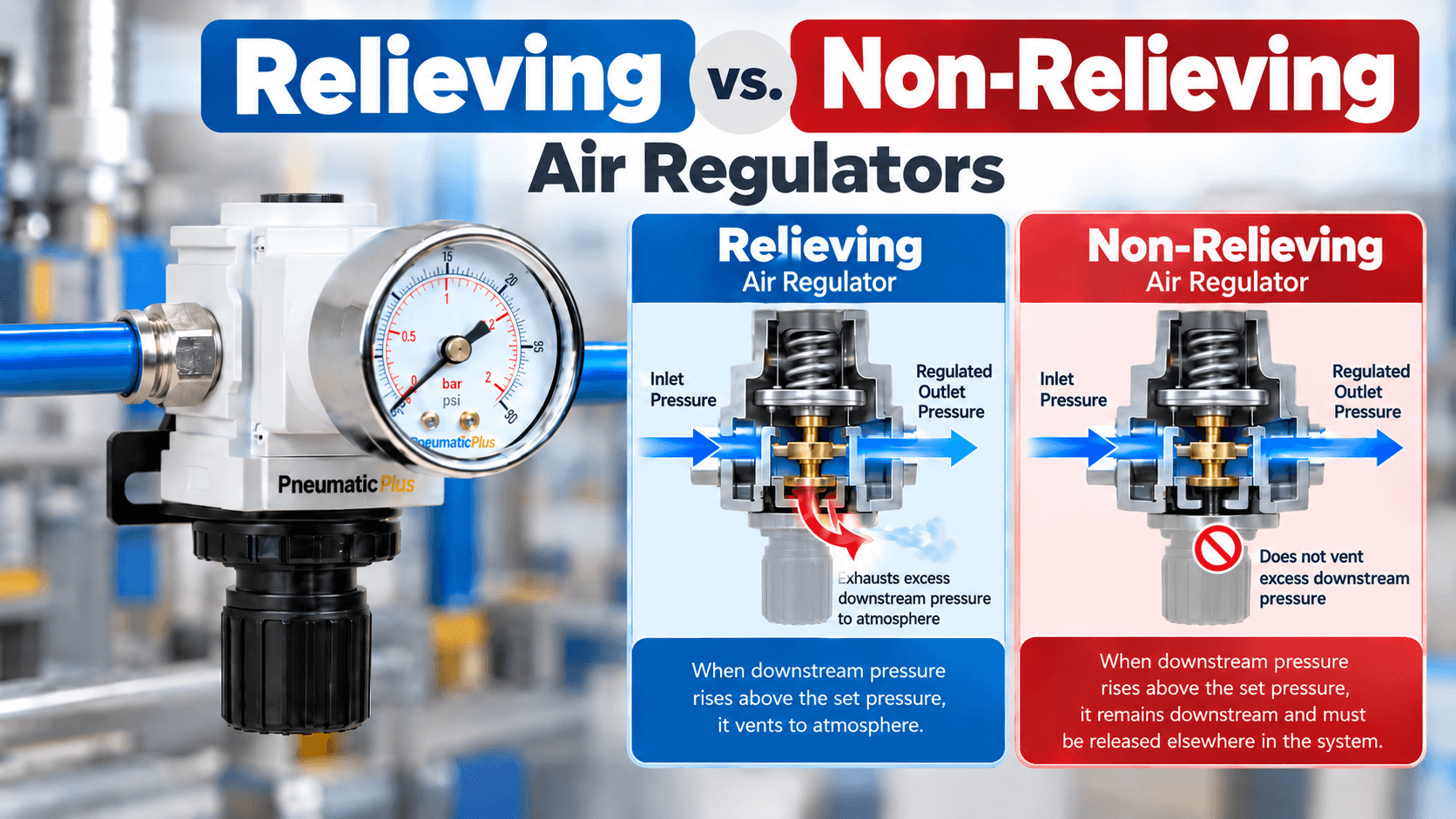
A relieving air regulator vents excess downstream air to atmosphere when downstream pressure rises above its set point. A non-relieving regulator has no vent path, so that excess pressure stays trapped until something downstream consumes it. In day-to-day use the difference shows up in one specific moment: what happens when you turn the pressure down on a line that has nowhere to flow.
It sounds like a footnote in a spec table. It isn't. It changes how the regulator responds to your hand on the knob, it decides whether a setting change takes effect immediately or not at all, and it comes with one safety limit that gets misunderstood often enough to be worth stating plainly.
What "Relieving" Actually Means
A relieving regulator — also called self-relieving — will vent downstream air if the pressure on its outlet side climbs above the pressure you've set.
The mechanism is built into the diaphragm assembly. In normal operation the diaphragm seals against the stem. When downstream pressure exceeds the set point, that excess pressure overcomes the adjusting spring force and lifts the diaphragm off the top of the stem, exposing a small orifice. The trapped air then escapes through a passage in the diaphragm assembly and out through the spring housing, which is why a relieving regulator hisses briefly from around the bonnet when you dial it down. Once downstream pressure comes back to the new set point, the diaphragm reseats and the venting stops.
Two situations trigger it:
- You lower the setting. You had 90 psi downstream and you want 50. The regulator's main valve closes, but the 90 psi already sitting in the line has to go somewhere. A relieving regulator sheds it and the gauge falls to 50.
- Downstream pressure rises on its own. Something on the far side pushes pressure back toward the regulator — a cylinder returning, thermal expansion in a closed volume, or a cross-connection from a higher-pressure branch. The regulator vents the excess rather than letting the outlet drift above the set point.
What "Non-Relieving" Means
A non-relieving regulator does the first half of that job and not the second. It will reduce pressure and hold a set point against supply variation and flow, but it provides no path for downstream air to escape.
The simplest and least expensive regulator architecture — an unbalanced poppet acting directly under an adjusting spring, with no separate diaphragm chamber — is typically non-relieving, and that design is common in miniature regulators. More elaborate designs with an isolated diaphragm chamber and an aspirator tube are generally self-relieving. (The design ladder is covered in How Air Pressure Regulators Work.)
On a non-relieving unit, turn the knob from 90 psi down to 50 on a dead-ended line and the outlet gauge will sit at 90 and stay there. Nothing is broken. There is simply no route out. The pressure will come down only when something downstream uses the air, or when you bleed the line yourself.
The Difference You'll Actually Notice
Here is the same adjustment on both types, on a closed line:
| What you do | Relieving regulator | Non-relieving regulator |
|---|---|---|
| Turn the setting up | Outlet rises to the new setting | Outlet rises to the new setting |
| Turn the setting down, dead-ended line | Brief vent, outlet falls to the new setting | Outlet stays at the old, higher pressure |
| Downstream pressure creeps above set point | Vents the excess | Holds the excess |
| Sound during adjustment | Short hiss from the bonnet, then quiet | Silent |
Raising pressure behaves identically on both. It is only the downward adjustment that separates them, which is exactly why the distinction gets missed until somebody is standing at a machine wondering why the gauge won't come down.
The practical risk with a non-relieving regulator is not dramatic, but it is real: an operator lowers the setting, walks away believing the downstream equipment is now at the lower pressure, and the equipment is still sitting at the old one. On a dead-ended circuit that mistake can persist indefinitely.
Why Relieving Is Standard for Shop and Plant Air
For compressed air, relieving is the sensible default and it is what the great majority of industrial air regulators are. Three reasons:
- It behaves the way people expect. Turn the knob down, the pressure goes down. No procedure to remember, no bleeding a line to make a setting take effect.
- The vented medium is air. Releasing a small volume of compressed air into the room costs essentially nothing and creates no hazard. That is not true of every gas.
- It keeps the outlet honest. If something downstream drives pressure above the set point, the regulator corrects it rather than letting the equipment see more pressure than you specified.
Every regulator in the PneumaticPlus SAR and PPR series is a relieving type, including the pilot-operated SAR825 and SAR925. Because they vent to atmosphere, they are compressed air regulators: if you are regulating something other than air, that changes the calculation entirely and you should talk to us or to a specialist for that gas before selecting anything.
When a Non-Relieving Regulator Is the Right Choice
Non-relieving types exist for applications where the escape of gas or fluid is prohibited because releasing it would create a hazard. In practice that means:
- Hazardous gases. Anything flammable, toxic, asphyxiant or corrosive. Venting into an enclosed workspace is not acceptable, and the relief path on a relieving regulator vents straight out of the bonnet.
- Expensive or specialty gases. Calibration mixes, high-purity gases and refrigerants are worth too much to bleed to atmosphere on every adjustment.
- Sealed or controlled environments. Cleanrooms, enclosures and processes where any discharge into the surrounding space is a contamination or safety question.
- Applications where discharge is prohibited by the governing code, permit or process specification for that installation.
All of those are process-gas territory rather than shop-air territory. If you are working with a gas other than compressed air, treat regulator selection as a specification exercise for that specific gas and get it reviewed by someone qualified in it.
The Limit Worth Knowing: Relieving Is Not Overpressure Protection
This is the part that gets misread, so it deserves to be direct.
The relief path on a relieving regulator is there to shed the modest amount of excess air created when you lower the set point or when downstream pressure drifts up. It is a control feature. It is not a sized overpressure protection device, and it should not be treated as one.
Consider the failure case. If a regulator's seat is damaged or held open by debris, or the diaphragm fails, the regulator can pass full supply pressure straight through to the downstream side. The small relief orifice in the diaphragm assembly was never intended to discharge that volume, and it will not protect downstream equipment rated below your supply pressure.
So: if your system has components rated below the available supply pressure, or an overpressure event would be hazardous or destructive, overpressure protection is a separate specification, sized for the credible failure case, and it belongs to a qualified professional for your installation rather than to a regulator's built-in vent. The same logic argues for checking the maximum supply pressure rating on whatever regulator you install — all PneumaticPlus SAR and PPR regulators are rated for 250 psi supply, but the equipment downstream of them may be rated for far less.
Treat this section as our general guidance rather than a code requirement: the right answer for a specific installation depends on the equipment, the pressures and the applicable standards.
How to Tell Which One You Have
Start with the paperwork. The product page or instruction sheet will say "relieving", "self-relieving" or "non-relieving" outright. That is the authoritative answer, and on the PneumaticPlus SAR and PPR pages the answer is relieving.
If you have an unlabeled regulator already installed, the behavior gives it away:
- Close the valve downstream of the regulator so the outlet side is dead-ended.
- Set a moderate pressure and let the outlet gauge settle.
- Turn the adjusting knob down.
- Relieving: you hear a short hiss and the outlet gauge follows the knob down. Non-relieving: the needle stays where it was.
- Depressurize the line before doing any further work on it.
A second clue: relieving designs need a vent path out of the spring housing, so the bonnet area has a small opening. A fully sealed bonnet suggests non-relieving. Confirm against the documentation rather than relying on appearance alone.
Troubleshooting: A Relieving Regulator That Won't Stop Venting
A brief hiss when you lower the setting is the vent working correctly. A hiss that never stops is a symptom. The usual causes, roughly in order:
- A damaged or perforated diaphragm. The most common cause of continuous venting. The diaphragm can no longer seal against the stem, so air escapes constantly instead of only when it should.
- Debris on the poppet seat. Pipe scale, rust or chips keep the main valve from closing fully, so pressure keeps creeping above the set point and the relief keeps shedding it. This is the failure a filter upstream of the regulator is there to prevent, and it is a good reason to confirm one is installed and serviced.
- Downstream pressure driven up from the far side. If a higher-pressure branch, a returning actuator or thermal expansion is pushing pressure back toward the regulator, the regulator is venting because it is supposed to. The regulator is reporting a system problem, not causing one.
- Set point above what the supply can hold. Worth ruling out before disassembling anything.
Depressurize the line before inspecting or servicing. If the regulator is venting continuously and the diaphragm is the cause, the air you are losing runs continuously too, which makes it a leak worth fixing promptly rather than living with. For the wider topic of finding and fixing losses, see How To Ensure Leak-Free Air Fitting Connections.
Choosing Your Regulator
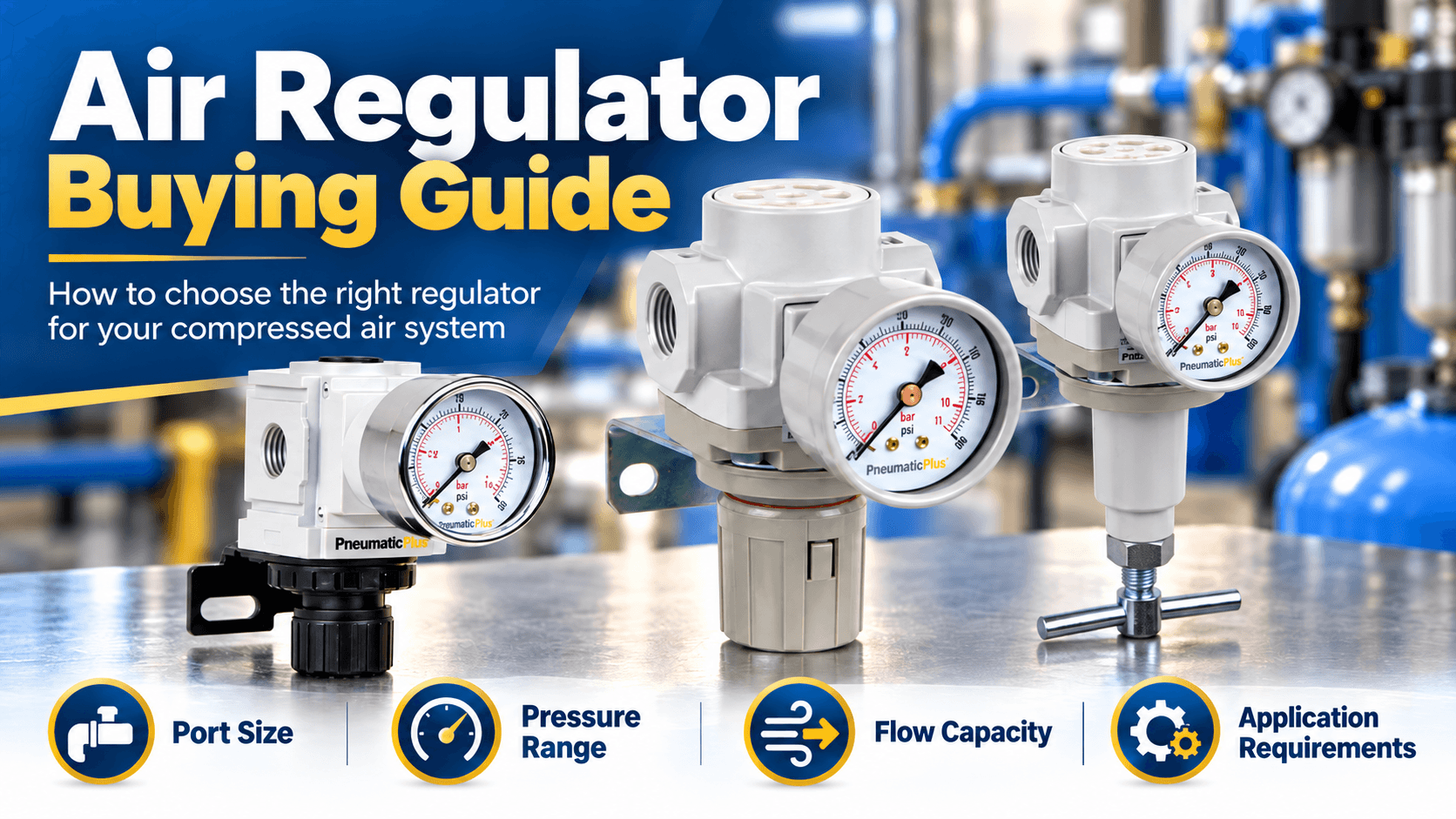
For compressed air, relieving is the default and the question usually resolves itself. The decisions that take real thought are port size, flow capacity and pressure range.
→ Air Pressure Regulator Buying Guide: Size, Flow & Range →
→ How Air Pressure Regulators Work →
→ Shop PneumaticPlus Air Pressure Regulators →
Educational information only. This article is provided by PneumaticPlus for general educational and informational purposes. Specifications are taken from the manufacturers' published data and may change; always confirm ratings on the product page and in the instruction sheet before you buy or install. Compressed air systems are under pressure and can cause injury or property damage if misused: shut off and depressurize the line before installing or servicing any component, and never exceed a component's rated pressure. Nothing here is a substitute for properly specified overpressure protection. This article is not engineering, safety or legal advice; consult a qualified professional for your application. All brand names and part numbers referenced are the property of their respective owners. PneumaticPlus is not affiliated with, endorsed by or sponsored by any other manufacturer, and "SMC style" describes the design style of the SAR series only; SAR regulators are not a direct replacement for SMC parts.