Refrigerated vs. Desiccant Air Dryers: Pros and Cons

Compressed air systems power countless industrial operations, from manufacturing assembly lines to pneumatic tools. However, compressed air naturally contains moisture that can cause significant problems if left untreated. Water vapor in compressed air leads to corrosion, freezing in cold environments, contamination of products, and premature failure of pneumatic equipment.
Air dryers solve this critical problem by removing moisture from compressed air systems. These essential components ensure your pneumatic equipment operates reliably while protecting your investment from costly damage. The two most common types—refrigerated and desiccant air dryers—each offer distinct advantages depending on your specific application requirements.
Understanding the differences between refrigerated and desiccant air dryers helps you make an informed decision that protects your equipment and optimizes your operations. The right choice depends on factors like your required dew point, operating environment, budget constraints, and maintenance capabilities.
How Refrigerated Air Dryers Work
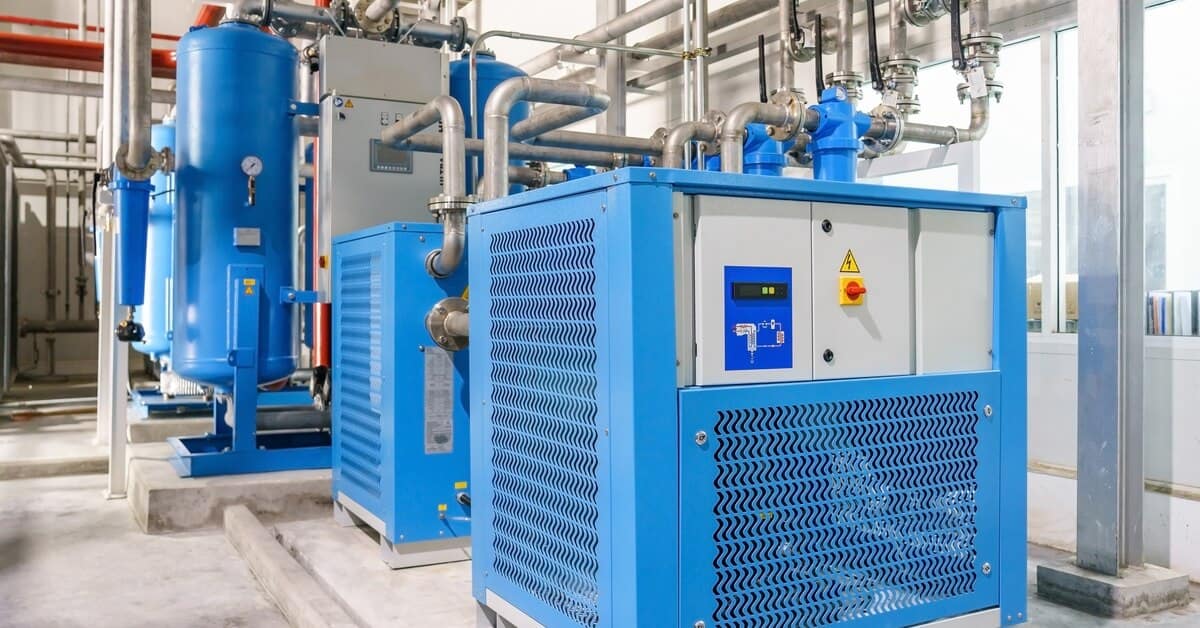
Refrigerated air dryers use a straightforward cooling process to remove moisture from compressed air. The system works by cooling the incoming compressed air to approximately 35–38 degrees Fahrenheit, causing water vapor to condense into liquid form. The system then separates and drains the condensed moisture, leaving drier air to continue downstream.
The process begins when hot, moisture-laden compressed air enters the dryer’s heat exchanger. Here, the incoming air transfers heat to the outgoing dried air, improving overall energy efficiency. The pre-cooled air then passes through an evaporator where refrigerant absorbs heat, further cooling the air and causing moisture condensation.
After moisture removal, the cold, dry air passes back through the heat exchanger where it’s reheated by incoming air before entering your pneumatic system. This reheating prevents condensation in downstream piping while maintaining the moisture removal benefits.
Refrigerated Air Dryer Advantages
Cost-effectiveness is the primary advantage of refrigerated air dryers. These units typically cost 50–70 percent less than comparable desiccant systems, making them attractive for budget-conscious operations. The lower initial investment allows more businesses to implement proper air treatment without breaking their capital equipment budgets.
Energy efficiency is another significant benefit. Refrigerated dryers consume relatively low amounts of electricity compared to other drying technologies. Most units operate continuously without the energy-intensive regeneration cycles required by desiccant systems, resulting in predictable and manageable operating costs.
Reliability and simplicity make refrigerated dryers popular across various industries. These systems have fewer moving parts and complex components compared to desiccant alternatives. The straightforward design translates to less frequent breakdowns and easier troubleshooting when issues arise.
Minimal maintenance requirements add to their appeal. Beyond regular filter changes and drain maintenance, refrigerated dryers need little attention to operate effectively. This low-maintenance characteristic reduces both direct maintenance costs and system downtime.
Refrigerated Air Dryer Limitations
Temperature limitations are the most significant drawback of refrigerated air dryers. These systems cannot achieve dew points below freezing, typically providing dew points of 35–40 degrees Fahrenheit. Applications requiring extremely dry air cannot rely on refrigerated technology alone.
Performance degradation occurs in high ambient temperatures. As surrounding temperatures rise, refrigerated dryers struggle to maintain their rated performance levels. This limitation makes them less suitable for hot industrial environments or outdoor installations in warm climates.
Contamination sensitivity affects refrigerated dryer performance. Oil carry-over from upstream compressors can coat the evaporator coils, reducing heat transfer efficiency and compromising moisture removal effectiveness. Proper upstream filtration becomes critical for optimal operation.
How Desiccant Air Dryers Function
Desiccant air dryers remove moisture through adsorption using specialized drying materials. These systems contain two towers filled with desiccant media, such as activated alumina or silica gel. While one tower actively dries compressed air, the other undergoes regeneration to restore its moisture-absorbing capacity.
The drying process occurs when compressed air passes through the desiccant media, which attracts and holds water molecules. The desiccant material can remove moisture down to extremely low levels, achieving dew points as low as -40 to -100 degrees Fahrenheit depending on the specific design and application requirements.
Regeneration becomes necessary to restore the desiccant’s effectiveness. This process involves heating the saturated media or purging it with dry air to drive off collected moisture. The regeneration cycle alternates between towers, ensuring continuous dry air production while maintaining system efficiency.
Desiccant Air Dryer Advantages
Ultra-low dew point capability sets desiccant dryers apart from other technologies. These systems can achieve dew points well below freezing, making them essential for applications requiring bone-dry air. Industries like pharmaceuticals, electronics manufacturing, and food processing often demand these extreme drying levels.
Temperature independence allows desiccant dryers to maintain performance regardless of ambient conditions. Unlike refrigerated systems, desiccant technology works effectively in both hot and cold environments without performance degradation.
Due to their critical application suitability, desiccant dryers work best for processes that cannot tolerate moisture contamination. Applications involving sensitive instruments, powder handling, or pneumatic conveying systems often require the superior drying capability desiccant technology provides.
Consistent performance characterizes well-maintained desiccant systems. These dryers deliver predictable dew points regardless of load variations or environmental changes, providing the reliability critical applications demand.
Desiccant Air Dryer Drawbacks
Higher initial investment is the most significant barrier to desiccant dryer adoption. These systems typically cost two to three times more than comparable refrigerated units, making them a substantial capital expenditure for many operations.
Increased energy consumption stems from the regeneration process required to restore desiccant effectiveness. The heating or purge air cycles consume significant energy, resulting in higher operating costs compared to refrigerated alternatives.
Complex maintenance requirements demand specialized knowledge and more frequent attention. Desiccant media eventually requires replacement, control systems need calibration, and regeneration components require regular inspection. This complexity increases both maintenance costs and the skill level required for proper service.
Compressed air consumption for regeneration reduces overall system efficiency. Purge-regenerated systems consume 10–20 percent of the dried air output for regeneration purposes, effectively reducing the available compressed air for productive applications.
Choosing the Right Application
Manufacturing environments with standard moisture requirements typically benefit from refrigerated air dryers. General plant air systems, pneumatic tools, and basic automation applications rarely require dew points below 35 degrees Fahrenheit, making refrigerated technology both adequate and cost-effective.
Critical applications demanding ultra-dry air necessitate desiccant technology. Pharmaceutical manufacturing, semiconductor production, powder coating systems, and pneumatic conveying operations require the extreme drying capability only desiccant systems provide.
Climate considerations influence dryer selection significantly. Operations in consistently hot environments may struggle with refrigerated dryer performance, while cold climate applications might benefit from refrigerated technology’s simplicity.
Making the Smart Choice for Your System
Selecting between refrigerated and desiccant air dryers depends on balancing performance requirements with cost considerations. Refrigerated systems excel in standard applications where moderate moisture removal suffices and budget constraints matter. Desiccant technology becomes essential when ultra-low dew points are nonnegotiable and operating costs are secondary to performance.
PneumaticPlus offers both refrigerated and desiccant air dryers designed to meet diverse industrial requirements. Our comprehensive range ensures you can find the optimal solution for your specific application, whether you need cost-effective moisture control or ultra-low dew point performance.
Proper air treatment extends equipment life, reduces maintenance costs, and offers reliable pneumatic system operation for years to come. Browse our selection to find the perfect option for your needs.